









All the books on this list are required reading.
But the most required is the first :
The Iliad is the most important book in the Greek canon.
All of subsequent Greek culture rests upon the Iliad, including its conception of Honour.
It's often said that the Iliad was the ancient Greek Bible, and that's correct :
The Iliad plays a huge role in the lives of the Greeks, and as I just said, all of Greek culture emerges from and rests upon the Iliad.
And not just ancient Greek culture, but all of subsequent Western culture emerges from and rests upon the Iliad, a brilliant work, about Warriors, about Warrior-Lovers, and about Honour, and the West was extremely fortunate and indeed blessed to have had such a formidable book appear at its foundation.
So it's essential that you read the Iliad, in the Lattimore translation, cover to cover -- and then read it again.
And you should, by the way, read it first -- before anything else.
Now :
There are many editions of the Lattimore translation.
This link takes you to listings for the edition I recommend, in an inexpensive but handsome, well-bound, and durable hardcover book, as provided on ABEbooks.com, a purveyor of used books.
You have to shop around on that list.
As of this writing, in August of 2018, a clean copy of this edition in good condition is running at about $20-30 with shipping.
And that's what I recommend you buy.
You can buy it for less, but you may not be happy with what you get.
And this is a book you'll want to spend a lot of time with.
Alexander the Great read his copy every day.
And that's what I recommend you do too.
This is a great book and it's very cheap. What the editor has done is take Jowett's standard 19th-century translation and correct the mistranslations and bowdlerized passages about homosex. Reading what Plato actually had to say about Male Love is eye-opening -- and very beautiful too.
The Symposion is required reading.
If you've never read Xenophon, this is your best introduction. The book's a real page-turner, and though the references to homosex are relatively few compared to the next book on our list, this book immerses you in the world of the ancient Greeks in a way that few others can. And like the Plato, it's inexpensive.
Though a little bit harder going than "The Persian Expedition," the reader's reward is reference after reference to same-sex love affairs among the Spartans and others. If you enjoyed "The Persian Expedition," try "A History of My Times" next.
An indispensable work. This is a series of biographies by a Greek-born author writing for a Roman audience ca. 100 AD, and references to male-male love affairs are scattered throughout. They're all good, but I recommend the entries on Lycurgus, Pelopidas, and Alexander -- just for a start.
Don't want to read all of Plutarch's lives?
This little volume, a Penguin classic edited by Richard J A Talbert, used to be called "Plutarch on Sparta."
That one is apparently out of print, but you can find it very cheaply on amazon.
Both "On Sparta" and "Plutarch on Sparta" include not only the standard Plutarch's Lives of Lycurgus, Agis, and Cleomenes, but also Xenophon's Spartan Society -- a brief essay which you won't want to miss.
In addition, there's Plutarch's Sayings of the Spartans -- also in both volumes.
The newer volume includes the Life of Agesilaus.
And the day I Iooked, "Plutarch on Sparta" was being offered used for $3.36.
You can't beat that.
Anyways, I discuss this book in the 300 message thread.
And I think it's a great book to own.
PLUS!!!
Penguin offers two companion volumes to "Plutarch on Sparta":
Both are by Plutarch, and both were translated by Ian Scott-Kilvert.
Excellent books, and right now, also very inexpensive.
Highly recommended.
Please note: This book is expensive. Although the article on homosexuality is a little stiff, related articles on everything from the agoge to athletics are terrific. Also: this URL takes you to the 1996 (3rd) edition, which is the one I use. There's a 2001 edition which I haven't seen, and a CD ROM as well. Those are a lot more expensive -- so you need to find out if they've been revised.
Osprey Military, a UK publisher, has three different series ("Elite," "Men-at-Arms," and "Warrior") of short, illustrated books about ancient warriors with titles like The Spartan Army, Hoplite, Germanic Warriors, Rome's Enemies: Celts and Britons, etc. Once in awhile the text is slightly homophobic -- that's true of "The Ancient Greeks" -- but most of the time it's right on the money -- that's true of the Spartans, the Celts, and so forth.
The books usually have 12 original artist's illustrations in full color, as well as about 40 photos of museum pieces and archaelogical sites. The illustrations by Angus McBride are particularly good.
These books are meant for hard-core military history enthusiasts only -- don't buy them unless you're really into strategy and tactics. But though there may only be one or two references to homoeroticism in any given book, I think the series editors have on the whole done a good and honest job of trying to give an accurate picture of what warrior life was like.
A truly beautiful evocation of a great man by a great writer.
The source for much of Renault's book, Arrian, a friend of the Emperor Hadrian, based his work on the memoirs of men who'd actually accompanied Alexander on his campaigns; this edition features the celebrated translation by Aubrey de Selincourt.
Don't expect Poliakoff to talk about male-male however; like most jocks of his era, he acts as though it didn't and doesn't exist among men into sports.
Still, Poliakoff is an excellent source on the guilds and sacred athletes of the Greco-Roman world.
And there are two others:
Both authors are highly respected classicists, Miller at UC Berkeley and Sweet at U Michigan.
Some people regard Sweet's book as more comprehensive, but actually I think the two books complement each other, and I recommend both -- along with Poliakoff.
The three books are eye-opening.
This is a work of great scholarship.
Ibson, who's chair of the Department of American Studies at Cal State, Fullerton, has, in this book, collected a series of photographs of American men in duos or larger groups from the period 1850 to 1950, and very thoughtfully analyzed the changes in male body language as American society went through the process which we call heterosexualization.
And while Ibson doesn't use that word, the process he describes and pictorially documents is exactly that:
a change from a way of life which was characterized by single-gender / homosocial spaces and environments, to one in which mixed gender -- heterosexualized -- environments are common and the culturally-enforced norm.
This change was accompanied by the medicalization of "homosexuality," a term which was coined in 1869.
Speaking of this change, and the nineteenth century, Ibson quotes the French philosopher Michel Focault:
...as long as friendship [between men] was something important, was socially accepted, nobody realized men had sex together. The disappearance of friendship [and the elevation of marriage] as a social relation and the declaration of homosexuality as a social/political/medical problem are the same process.
And that's a key statement, which I would slightly re-phrase and put thus: "The disappearance of male-male friendship and the elevation of heterosexual marriage as a social relation and the declaration of homosexuality as a social/political/medical problem are the same process."
This is a scholarly book, it's heavily footnoted, and it's not always easy going.
But it's an important book for any Man who Loves Men to read and understand.
This is a work of tremendous scholarship, and I highly recommend it.
Indeed, there are no superlatives I can use, which would be adequate to this book.
There are many books about aspects of Greek culture.
And there are many books which attempt to sum up Greek culture.
And then there's Werner Jaeger's Paideia -- which has no equal.
Paideia, by the way, is pronounced Pie-day-a -- short "a" -- and the word originally meant child-rearing;
but it eventually came to have the highest meaning of "Culture" the Greeks and the Greek language possessed.
For, as you'll see, the Greeks came to believe that Paideia -- the molding, or, we might say, making, of the Man through education in its broadest sense -- was the highest act of their civilization.
And Jaeger's exposition of Paideia -- is brilliant.
Volume I, which is easy to find used and relatively cheap, will take you from Homer through Plato.
And it's a wonderful journey.
Here's Jaeger in his own words from the Introduction:
The unique position of Hellenism in the history of education depends on the ... supreme instinct to regard every part as subordinate and relative to an ideal whole -- for the Greeks carried that point of view into life as well as art -- and also on their philosophical sense of the universal, their perception of the profoundest laws of human nature, and of the standards based on them which govern the spiritual life of the individual and the structure of society. For (as was realized by Heraclitus, with his keen insight into the nature of the mind) the universal, the logos, is that which is common to all minds, as law is to all citizens in the state. In approaching the problem of education, the Greeks relied wholly on this clear realization of the natural principles governing human life, and the immanent law by which man exercises his physical and intellectual powers.
To use that knowledge as a formative force in educatlon, and by it to shape the living man as the potter moulds clay and the sculptor carves stone into preconceived form -- that was a bold creative idea which could have been developed only by that nation of artists and philosophers. The greatest work of art they had to create was Man. They were the first to recognize that education means deliberately moulding human character in accordance with an ideal. 'In hand and foot and mind built foursquare without a flaw' -- these are the words in which a Greek poet of the age of Marathon and Salamis describes the essence of that true virtue which is so hard to acquire.
Only this type of education deserves the name of culture, the type for which Plato uses the physical metaphor of moulding character. The German word Bildung clearly indicates the essence of education in the Greek, the Platonic sense; for it covers the artist's act of plastic formation as well as the guiding pattern present to his imagination, the idea or typos.
Throughout history, whenever this conception reappears, it is always inherited from the Greeks; and it always reappears when man abandons the idea of training the young like animals to perform certain definite external duties, and recollects the true essence of education. But there was a special reason for the fact that the Greeks felt the task of education to be so great and so difficult, and were drawn to it by an impulse of unparalleled strength.
That was due neither to their aesthetic vision nor to their "theoretic" mentality. From our first glimpse of them, we find that Man is the centre of their thought. Their anthropomorphic gods; their concentration on the problem of depicting the human form in sculpture and even in painting; the logical sequence by which their philosophy moved from the problem of the cosmos to the problem of man, in which it culminated with Socrates, Plato, and Aristotle; their poetry, whose inexhaustible theme from Homer throughout all the succeeding centuries is man, his destiny, and his gods; and finally their state, which cannot be understood unless viewed as the force which shaped man and man's life -- all these are separate rays from one great light. They are the expressions of an anthropocentric attitude to life, which cannot be explained by or derived from anything else, and which pervades everything felt, made, or thought by the Greeks.
Other nations made gods, kings, spirits: the Greeks alone made Men.
~ Jaeger, xxii
The Ideals of Greek Culture -- indeed.
Werner Jaeger's Paideia.
In addition to this "traditional" reading, there are five online resources I recommend:
This is a very important discussion, authored by the editor of the prestigious UK medical journal The Lancet, and which first appeared in The New York Review of Books, of the pseudo-science behind not just the "search" for a "gay" gene, but which props up the entire myth of sexual orientation.
Don't miss it.
We discuss her op-ed in a number of places, including:
And this far more recent post:
I love the female body, but the cock is also wonderful;
in which I summarize some of Coontz' points:
The Perseus Project presents ancient texts in both English and their original language -- Greek or Latin.
And there's a lot there.
Here's how to use it:
Go to any page in the project.
For example, this link takes you to a section from Plutarch's Life of Lycurgus:
The boy who excelled in judgement and was most courageous in fighting, was made captain of his company; on him the rest all kept their eyes, obeying his orders, and submitting to his punishments, so that their boyish training was a practice of obedience. Besides, the elder men used to watch their training, and by egging them on to fighting and strife, learned accurately how each one of them was naturally disposed when it was a question of boldness and aggressiveness in their struggles.
In the upper right hand corner of the page, at the very top, you'll see a search box.
Type in the name of the author and the work you want to see.
For example, Xenophon, Anabasis.
Hit "search," and you'll get a list of works by Xenophon.
And then just click the link you want.
So: you don't have to go to the library, you don't have to buy a book.
Just use Perseus.
In the 1930s, Paul Shorey, a classicist and Platonist of vast erudition, translated Plato's Republic for Harvard's Loeb Classical Library.
Shorey included notes, and two introductions, one for each volume of the Harvard edition. (Plato's Republic consists of ten "books" or chapters. Volume I of the Loeb contains Books 1-5, Volume 2, Books 6-10.)
Shorey's translation, with his original notes, of Plato's Republic can be found here on Perseus.
Shorey's two introductions to the two-volume Harvard edition of Republic do NOT appear on Perseus, but they can be found, mirabile dictu, on archive.org, along with the rest of the text:
Paul Shorey's Introduction to Volume I of Plato's Republic.
Paul Shorey's Introduction to Volume II of Plato's Republic.
These introductions are essential reading.
Shorey wrote many other books and articles, but they tend to be too scholarly for the average visitor to this site.
Nevertheless, some of you may want to look for Shorey's What Plato Said, which can be found used, often in an abridged edition from the 1960s.
Finally, there's Gore Vidal's Julian: A Novel.
This is the book's description on amazon:
Julian the Apostate, nephew of Constantine the Great, was one of the brightest yet briefest lights in the history of the Roman Empire. A military genius on the level of Julius Caesar and Alexander the Great, a graceful and persuasive essayist, and a philosopher devoted to worshipping the gods of Hellenism, he became embroiled in a fierce intellectual war with Christianity that provoked his murder at the age of thirty-two, only four years into his brilliantly humane and compassionate reign. A marvelously imaginative and insightful novel of classical antiquity, Julian captures the religious and political ferment of a desperate age and restores with blazing wit and vigor the legacy of an impassioned ruler.
Vidal's book isn't perfect, but it describes well the Hellenist attitude towards traditional Greco-Roman religions, and towards Christianity.
And is therefore recommmended.
Also recommended is our own Warrior Logan McClintock's graceful essay The Anal Sex Myth: A Frottage Manifesto, which talks about Mr Vidal, and his thinking about both Frot and male-male.
And, from Edward Gibbon's Decline and Fall of the Roman Empire, Chapter XXVIII The Destruction of Paganism and the Rise of the Cult of Saints.
is presented by The Man2Man Alliance, an organization of men into Frot
Click here to read An Introduction to Frot and The Man2Man Alliance.
And here to learn more about Heroes.
Or here to visit our FAQs page and learn more about Frot Men.
© All material on this site Copyright 2001 - 2018 by Bill Weintraub. All rights reserved.
|
Finally:
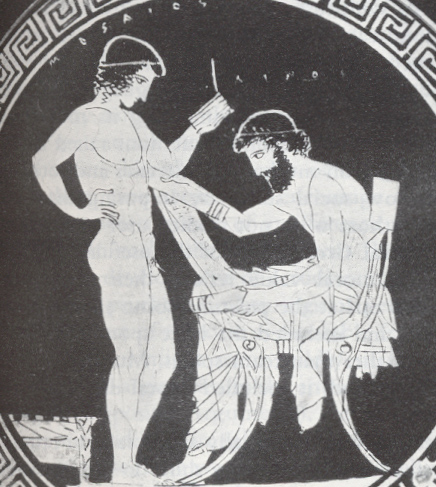
This vase painting is reproduced in The Oxford History of the Classical World, where it's entitled "the reading lesson."
Right.
The guy's reading the youth's dick.
What's of more interest here is that the painter has given his subjects mythological names -- Musaeus and Linus -- a musician and a poet who come from a slightly different tradition of Greek homosex.
Because both were Orphics -- a mystic cult which can be thought of as a distant precursor to Christianity, and whose followers spent a lot of time in the woods celebrating various solemn, all-male, rites.
What we can see in the painting is that the erotic focus is on the youth's genitals -- which is what we'd expect in a society built on Frot.